

Digital Operations
Auditing Website Order Status Before It Misleads Customers
DispensaryVA Editorial TeamPublished
website order status auditdispensary operationsworkflow records
Powered by StealthAgents
Digital Operations
Published August 27, 2026.
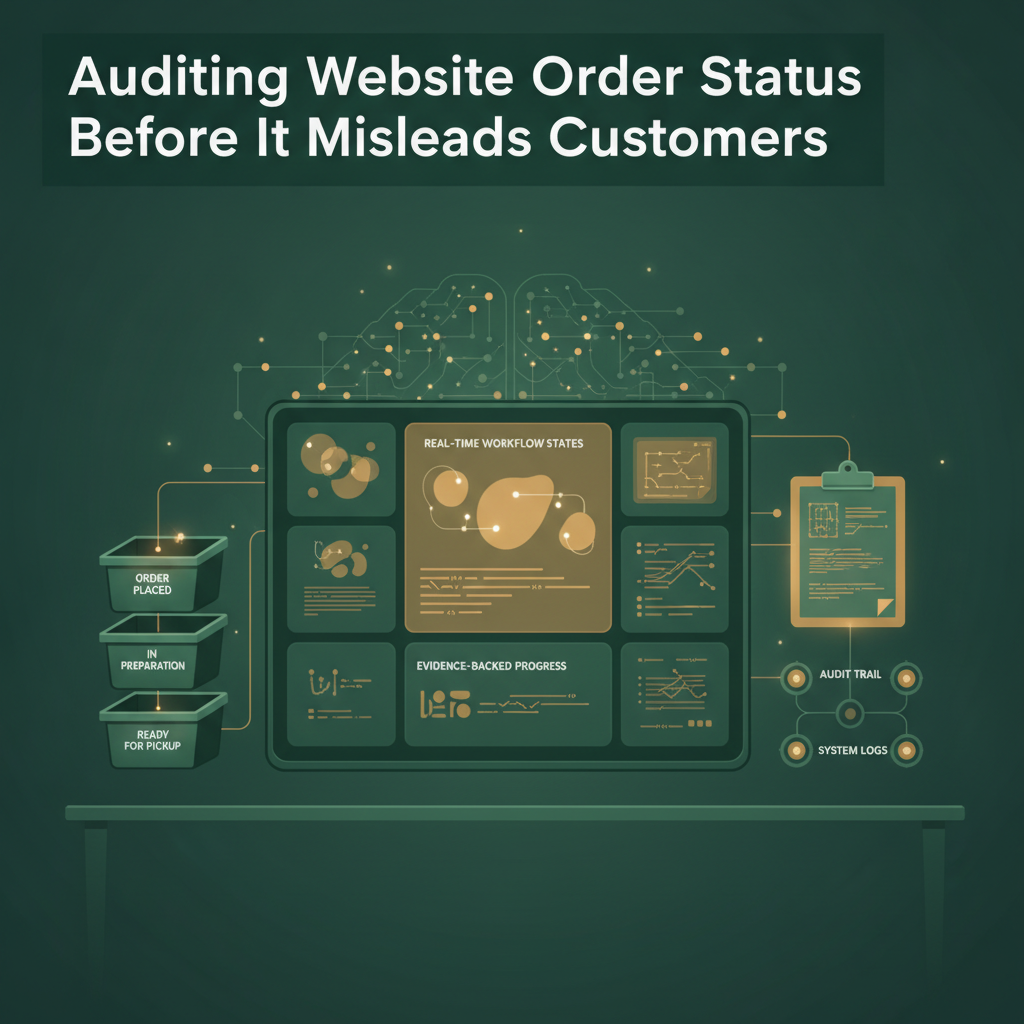
Order status labels should reflect evidence-backed workflow states instead of acting as optimistic guesses assembled from disconnected systems. In a cannabis dispensary, the work is rarely difficult because no one cares about accuracy. It is difficult because a single operational moment is represented by several systems, roles, and clocks. A useful review turns that ambiguity into a bounded question: what can be verified now, what must remain open, and who is authorized to decide?
This guide is for operators who need a dependable administrative method around website order status audit. It is not a legal opinion, a product-safety determination, or a promise that one checklist fits every jurisdiction. The goal is a traceable queue that keeps customer service, inventory, compliance, and management decisions connected without pretending they are the same decision.
The control can be tested with one ordinary case and one exception. For the ordinary case, verify that the expected fields appear in the right sequence. For the exception, verify that the process creates a visible stop, preserves evidence, and routes ownership. A test that checks only the happy path cannot show whether the queue protects a real decision under pressure.
Start with the smallest unit that can be checked. In this case, that is status source, timestamp, order state, customer notice, correction owner. A queue becomes unreliable when a broad label stands in for several different events. The reviewer should record what was observed, when it was observed, which system supplied the observation, and what remains unknown. That modest discipline makes the next question visible without turning an exception into a conclusion.
Keep role boundaries explicit. An administrative reviewer can reconcile records, request missing evidence, prepare a summary, and monitor an open queue. The authorized manager, quality lead, regulatory contact, financial approver, or other designated decision-maker must make decisions reserved to that role. Documentation support is valuable precisely because it leaves the decision with the person who owns it.
The first review pass is about identity. Match the status source to the transaction, item, person, or shift at issue, then preserve the original value beside any corrected value. Do not overwrite a source field merely to make two systems agree. A correction is a new event with an owner and timestamp; it is not proof that the earlier record never existed.
Close with a legible status sentence: what happened, what is protected, what evidence is attached, what decision was made, and who owns the next review. Recheck the record after the next shift or operating cycle. Reliability comes from making the right small fact available at the right moment, not from making every record look identical.
Next, separate fact from interpretation. A cancelled or held order remains visible as ready for pickup is a useful trigger, but it does not establish cause or authorize disposition. Compare the record with the applicable policy and ask which role may decide the next step. If the authority is unclear, stop at a documented hold and route the question to the responsible owner.
Start with the smallest unit that can be checked. In this case, that is status source, timestamp, order state, customer notice, correction owner. A queue becomes unreliable when a broad label stands in for several different events. The reviewer should record what was observed, when it was observed, which system supplied the observation, and what remains unknown. That modest discipline makes the next question visible without turning an exception into a conclusion.
Evidence quality depends on sequence. Preserve the initiating record, the review action, the response, and the closing decision in that order. Screenshots can help show what a user saw, but they should not be the only copy of a timestamp, identifier, or status. Keep exports, notes, and system references linked so another reviewer can retrace the path.
The first review pass is about identity. Match the status source to the transaction, item, person, or shift at issue, then preserve the original value beside any corrected value. Do not overwrite a source field merely to make two systems agree. A correction is a new event with an owner and timestamp; it is not proof that the earlier record never existed.
A practical exception table has four columns: state, evidence available, risk of acting, and next owner. Use states such as open, awaiting source confirmation, approved for the next controlled action, and closed with rationale. Avoid vague labels like resolved when the record only shows that someone acknowledged it. A clear unresolved state is safer than a confident but unsupported closure.
Next, separate fact from interpretation. A cancelled or held order remains visible as ready for pickup is a useful trigger, but it does not establish cause or authorize disposition. Compare the record with the applicable policy and ask which role may decide the next step. If the authority is unclear, stop at a documented hold and route the question to the responsible owner.
The handoff should be written for a person who was not present. Name the queue, the item or case, the last verified event, the missing evidence, and the deadline or trigger for recheck. Avoid copying sensitive customer details into broad channels. Link to the restricted record and describe only the minimum context needed for the receiving role to act.
Evidence quality depends on sequence. Preserve the initiating record, the review action, the response, and the closing decision in that order. Screenshots can help show what a user saw, but they should not be the only copy of a timestamp, identifier, or status. Keep exports, notes, and system references linked so another reviewer can retrace the path.
Reviewers should also look for recurrence without overstating a trend. Group comparable events by stable definitions, such as Order status labels should reflect evidence-backed workflow states instead of acting as optimistic guesses assembled from disconnected systems., and note changes to software, staffing, policy, or operating hours. A growing count may reflect better detection; a falling count may reflect missing data. Report the measurement condition beside the count instead of presenting a clean number as an outcome.
A practical exception table has four columns: state, evidence available, risk of acting, and next owner. Use states such as open, awaiting source confirmation, approved for the next controlled action, and closed with rationale. Avoid vague labels like resolved when the record only shows that someone acknowledged it. A clear unresolved state is safer than a confident but unsupported closure.
The control can be tested with one ordinary case and one exception. For the ordinary case, verify that the expected fields appear in the right sequence. For the exception, verify that the process creates a visible stop, preserves evidence, and routes ownership. A test that checks only the happy path cannot show whether the queue protects a real decision under pressure.
The handoff should be written for a person who was not present. Name the queue, the item or case, the last verified event, the missing evidence, and the deadline or trigger for recheck. Avoid copying sensitive customer details into broad channels. Link to the restricted record and describe only the minimum context needed for the receiving role to act.
Keep role boundaries explicit. An administrative reviewer can reconcile records, request missing evidence, prepare a summary, and monitor an open queue. The authorized manager, quality lead, regulatory contact, financial approver, or other designated decision-maker must make decisions reserved to that role. Documentation support is valuable precisely because it leaves the decision with the person who owns it.
This operational guide uses public information from the Virginia Cannabis Control Authority, the Virginia Department of Health Professions, and the National Institute of Standards and Technology. These sources inform recordkeeping, measurement, and responsible escalation. They do not replace a dispensary’s current authorization, legal advice, accounting policy, privacy policy, or product decision process.