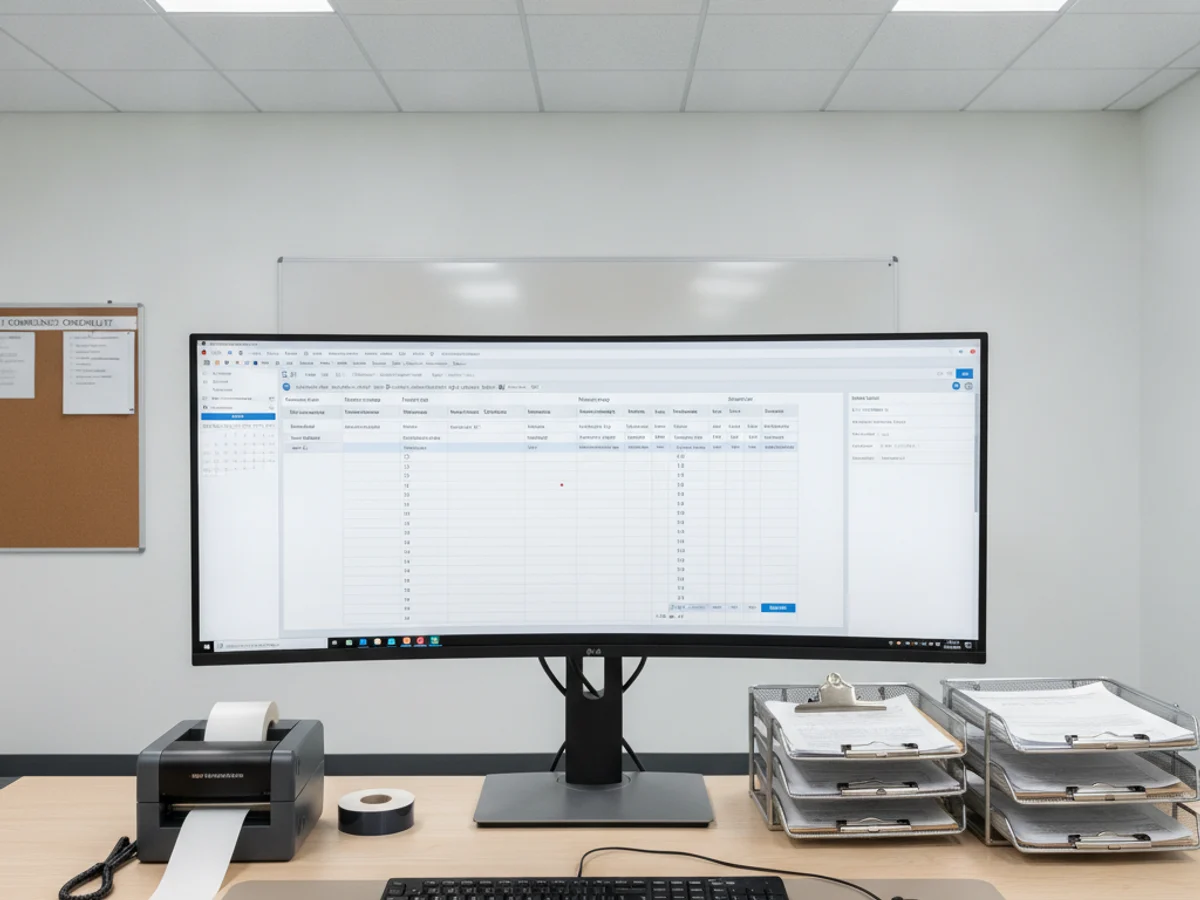
When the record concerns waste records, preserve the vocabulary used by the people doing the work. A receiver may describe a package differently from a finance reviewer; a customer may describe a service differently from a website editor. Add the operational term, then add the plain-language explanation. That pairing prevents a later search from missing the event. It also makes coaching specific: the team can see whether the problem was detection, communication, authority, timing, or follow-through rather than treating every exception as a generic paperwork gap.
Evidence context for this decision
Research question Can a retailer measure waste-record completeness without confusing a documented event with the amount of material physically destroyed? The unit is one waste event or approved adjustment linked to a product or lot. The population is all events expected under the retailer’s defined process and period. A register of found forms is not necessarily a register of all events. Virginia cannabis oversight, EPA waste guidance, OSHA safety material, and IRS recordkeeping principles support retaining an attributable description, quantity, reason, authorization, and disposition. They do not publish a common cannabis waste percentage. The evidence supports a record-control conclusion, not a universal operational benchmark. ## Evidence and measurement Capture the source identifier, product or lot, quantity and unit, reason, event date, witness or approver, method, destination, and system posting. Keep the original unit and any converted unit. A weight and a package count cannot be combined without a stated conversion. If a record is voided, retain the void reason and revision history. Completeness should be measured against expected fields and expected events separately. Field completeness asks whether required evidence is populated. Event reconciliation asks whether system movements have a corresponding approved record. Neither proves the physical disposition occurred. A photo, witness statement, or downstream record may support disposition depending on the governing procedure. | State | What it shows | What remains open | | --- | --- | --- | | Recorded | An event was entered | Physical disposition | | Authorized | A responsible review occurred | Execution | | Disposed | A disposition was documented | Completeness of population | ## Interpretation and limitations A rise in waste records can reflect a product change, better capture, or actual increase. A fall can reflect lower waste or missing entries. Interpret trends only after checking purchasing, receiving, packaging, product mix, and system changes. Report missing and not-applicable fields distinctly; a blank quantity is not zero. The method transfers only where the same units, legal rules, and disposal definitions apply. Public environmental guidance can inform terminology but cannot certify a site’s procedure. Do not infer employee fault from a missing field without reviewing access, training, and the record’s revision history. ## Separating expected events from found forms Completeness has two denominators. Field completeness asks whether each recorded event contains the required identifiers, quantity, reason, authority, and disposition. Event completeness asks whether the events that should exist under the process can be reconciled to the register. A site can have excellent fields on the forms it finds while missing events that were never entered. Report these measures separately and state how the expected population was constructed. Start with the movement that should create a waste record. A damaged package, expired item, failed quality check, spill, return-to-waste decision, or inventory correction may have different triggers. Reconcile the waste register to inventory postings, cycle counts, production or packaging records, and approved destruction logs where relevant. The crosswalk should preserve source identifiers rather than relying on title or date alone. A date-only match can incorrectly connect two events occurring on the same day. Quantity needs an explicit unit and sign. Package count, weight, volume, and unit count answer different questions. Preserve the original value, conversion method, scale or device identifier where relevant, and rounding rule. Blank is not zero, and “not measured” is not “not applicable.” If a product is opened and only part is discarded, record the policy-defined unit and explain how the remainder is handled. Do not convert across product types using an assumed average. Authorization and execution are separate. A witness signature can show that a required step was documented. It does not independently prove the quantity or physical disposition. Link the record to the approved method, date, location, and downstream evidence required by the operator’s procedure. If a record is corrected, retain the original and correction reason. If a record is voided, report the void rather than allowing the final table to imply that the event never existed. Trend analysis should include mix and capture changes. More waste records may follow a new reporting rule, tighter measurement, a product shift, or actual increased loss. Fewer records may reflect improvement or under-capture. Compare product category, package format, sales volume, receiving volume, and operating days where those denominators are relevant. Note changes in staff, disposal vendor, system, and training. A percentage without its exposure and process version is not a stable benchmark. Missingness deserves a disposition. An unavailable source record may be pending migration, inaccessible under current permissions, never created, or destroyed under an approved schedule. Use separate statuses and name the next review owner. Do not infer employee fault from a blank field; check the form version, training, access history, and whether the field was required at the time. Keep personal data limited to what the authorized review needs. EPA, OSHA, IRS, and Virginia sources address different environmental, workplace, tax, and cannabis record scopes. They support careful evidence design but do not certify one operator’s physical disposal or provide a universal waste rate. The bounded conclusion is that waste-record completeness can expose gaps in expected-event reconciliation and field quality, while physical fate and causal responsibility require additional evidence. ## A practical comparison boundary Set the review cutoff and preserve late-entered or corrected records as late evidence. A cleaner final register may reflect backfilling rather than better contemporaneous capture. Report the state at the cutoff and the state after reconciliation. This makes the difference between record completeness and retrospective repair visible. ## What a reviewer should request Request the expected-event source, waste register, inventory posting, authorization, unit conversion, and disposition evidence for the same cutoff. A folder of signed forms cannot establish event completeness if the expected population is unknown. Preserve missing, late, voided, and corrected states so the review measures both contemporaneous capture and later reconciliation. ## Why reconciliation should be repeatable A reviewer should be able to rerun the crosswalk from the same cutoff and obtain the same expected-event list, subject to documented late entries. Record filters, source versions, and exclusion rules. If two systems disagree, preserve both values and the reconciliation decision. Reproducibility is evidence quality; it is not the same as claiming that either system is physically complete. ## Interpreting a completeness change An increase in populated fields may show better data capture rather than more waste. Check whether the form, required fields, disposal vendor, and expected-event source changed. Compare the contemporaneous measure with the reconciled measure and identify late backfills. This keeps a record-quality improvement separate from a claim about physical material or operational performance. ## A final evidence check Before publishing completeness, ask whether the expected-event source is known and whether units, authorization, correction, and physical disposition are separate. Ask whether late backfills and missing records are visible. If not, report field quality and event reconciliation as limited measures rather than claiming that the waste register represents all physical events. ## Reading uncertainty correctly An approved form with no downstream disposition is not the same as a completed physical event. Keep the authorization evidence and execution evidence distinct. If the procedure does not require a particular downstream record, record that boundary explicitly rather than filling the gap with an assumption. This makes the result usable without claiming more than the process can observe. ## Bounded conclusion Waste research is most useful when event identity, quantity, authority, and disposition are linked but not collapsed into one score. It can reveal where evidence is incomplete. It cannot alone prove the physical fate of material or explain why the trend changed. ## Sources 1. Virginia Cannabis Control Authority 2. EPA Managing Waste 3. OSHA Recordkeeping 4. IRS Recordkeeping ## Research question and direct answer This article examines callfocus dispensary call call callfocus volume through a callfocus bounded research inbound callfocus question: What a callfocus call-volume series abandonment callfocus can show about callfocus demand and callback callfocus what it cannot callfocus show about service-window callfocus service quality. The callfocus review uses seasonality callfocus public sources available callfocus through August call callfocus 13, 2026 and callfocus treats the inbound callfocus dispensary record as callfocus the local abandonment callfocus unit
Applying the evidence to waste records
Use a chronological ledger for waste records. Start with the trigger, add the first safeguard, record each verification, and finish with the disposition. The useful fields are material, quantity, reason, witness, method, and system reference. Keep original values visible when a correction is needed. If a number, identity, or timestamp is unknown, mark it unknown and assign a person to obtain it. Quiet backfilling makes a clean-looking record less trustworthy. Review a small sample at a predictable time. Read one open case for ownership and one closed case for evidence. Look for repeated delays, copied explanations, missing witnesses, late timestamps, and actions that depend on memory. A trend is not proof of fault; it is a prompt to inspect the design. Ask whether waste records gives staff a clear stopping point and an easy way to surface an exception before it becomes a customer or compliance problem.