

Delivery Operations
How to Review a Cannabis Dispensary Delivery Route Exception
DispensaryVA Editorial TeamPublished
delivery exceptionsroute reviewcannabis logistics
Powered by StealthAgents
Delivery Operations
Published August 24, 2026.
A delivery route exception is ordinary administrative work with an unusually important evidence boundary in a cannabis dispensary. Public guidance, applicable Virginia requirements, product specifications, and the dispensary's own records can change the correct action. This article describes an administrative review method, not legal, medical, tax, security, employment, or regulatory advice. Keep the final decision with the role authorized to make it.
Measure the workflow with a denominator. For this process, useful measures include stops with verified milestones, exception age, proof gaps, and deliveries needing authorized follow-up. Report incomplete or unmonitored intervals separately. A lower count may mean fewer events, better prevention, a changed threshold, or missing records. A higher count may mean a new detection practice rather than worse operations. State the period, population, exclusions, and source before comparing results.
A reviewer should test the relationship between the signal and the conclusion. Does the record identify the affected one delivery stop and its relevant time interval? Does it show the action that protected the customer, product, privacy, cash, or operating continuity? Does the cited source support the conclusion being drawn? If the answer to one question is no, keep the item open or route it for the decision that the evidence can actually support.
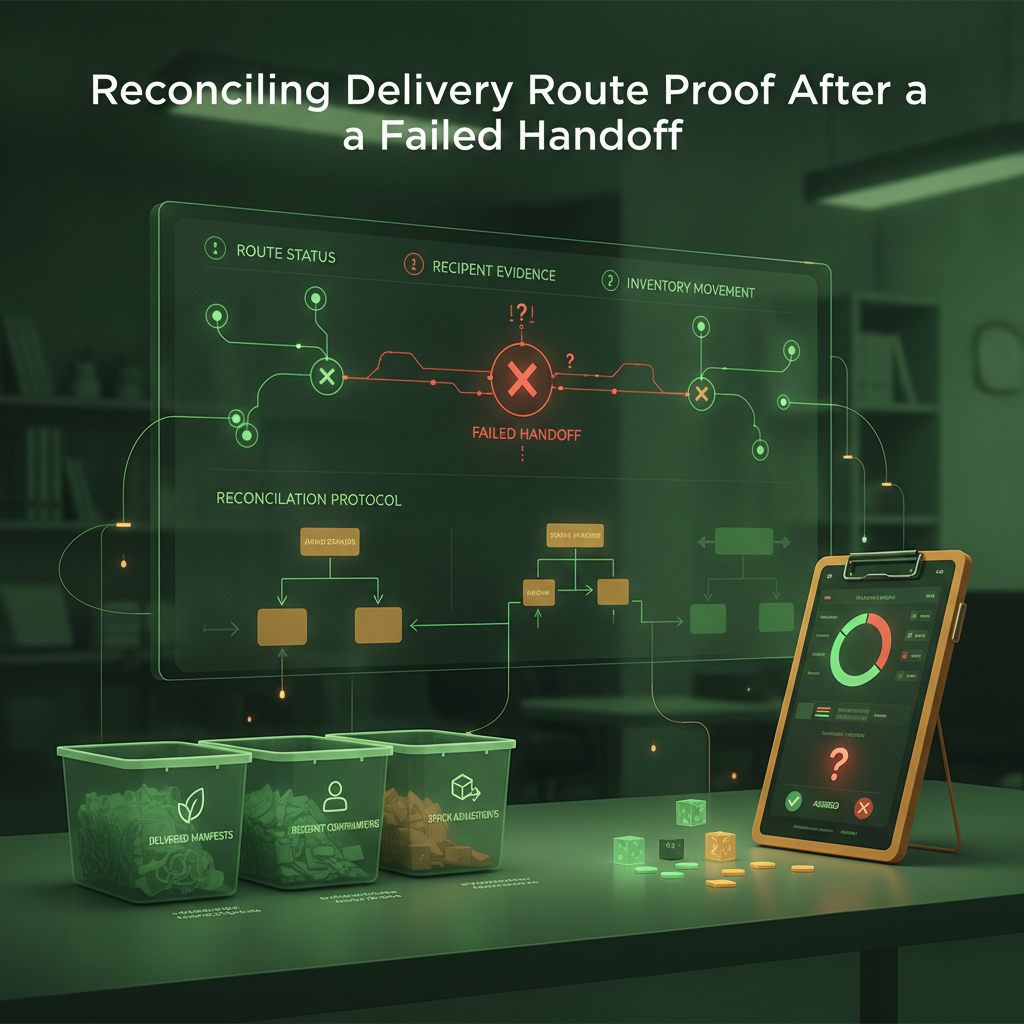
Begin by freezing the review window. Write down the one delivery stop and its relevant time interval, the system or physical source, the timestamp, and the person who first observed the condition. A broad label such as “issue” is not enough because it collapses the trigger, the affected record, and the requested outcome. For a delivery route exception, the first useful question is what was visible at the time, not what a later summary says should have happened. A route trace may show movement; it does not alone establish custody, delivery completion, or customer receipt.
Measure the workflow with a denominator. For this process, useful measures include stops with verified milestones, exception age, proof gaps, and deliveries needing authorized follow-up. Report incomplete or unmonitored intervals separately. A lower count may mean fewer events, better prevention, a changed threshold, or missing records. A higher count may mean a new detection practice rather than worse operations. State the period, population, exclusions, and source before comparing results.
Incomplete evidence is itself a state worth recording. Mark the missing field, the source that was expected to provide it, the time the gap was discovered, and the person responsible for obtaining or evaluating it. Do not fill a blank with a guess simply because the workflow is waiting. For a delivery route exception, a missing identifier, timestamp, approval, witness, or reconciliation can change the meaning of the entire record. The next operator should be able to see whether the gap is harmless, whether a temporary safeguard is active, and when the item will be reviewed again.
If two systems disagree, preserve both values and describe the comparison rather than choosing the more convenient one. Record which system is authoritative for the immediate decision and which owner must resolve the conflict. This keeps a short-term containment action separate from a later correction. It also helps the dispensary distinguish a data-quality problem from an operating failure. A route trace may show movement; it does not alone establish custody, delivery completion, or customer receipt. A clean closeout can follow only after the missing or conflicting evidence has been addressed, explicitly accepted by the authorized owner, or carried forward with a named next action.
A dependable a delivery route exception routine makes the relevant source visible, assigns the delivery operations reviewer with authority over the next action the next authorized action, and records what remains uncertain. That discipline helps a cannabis dispensary protect its operating decisions without claiming that an administrative record proves more than it does.